
HAR → .http converter
Drop a .har capture from your browser's DevTools Network tab and get clean, runnable .http requests — one per call, headers and bodies kept. It all happens in your browser: nothing is uploaded.
Converts automatically — nothing leaves your browser.
Your .http requests will appear here.
Your .http file is ready.
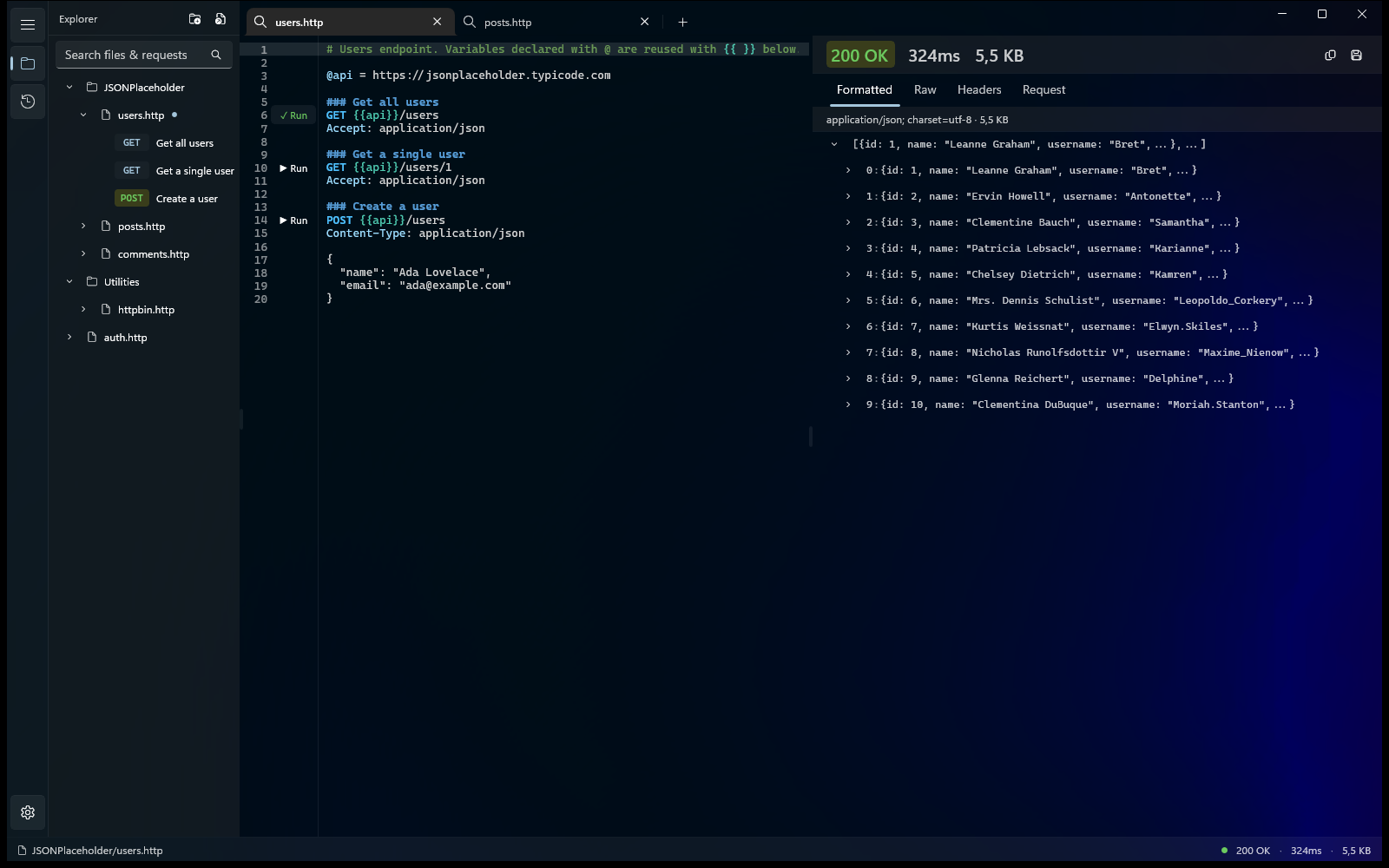
Run, organize, and debug it in Karve — one native Windows workspace for the .http files already scattered across your repos. Files stay where they are and keep working with Git.
- Workspace tree across repos
- Response viewer
- Environment switching
- Searchable history
15-day free trial · No account · No subscription
What it does
- One ### request per captured call, in order
- Full URL with query, every request header, and the request body
- Rebuilds form bodies from postData.params
- Only XHR/Fetch skips images, CSS, scripts, and fonts
- Drops HTTP/2 :pseudo headers and (optional) sec-* noise
- Pretty-prints JSON bodies
Get a HAR file
In your browser, open DevTools → Network, reproduce the calls, then right-click the list → Save all as HAR. Drop that file here. New to the .http format? Read the .http guide.
Have a spec instead? OpenAPI → .httpCommon questions
How do I convert a HAR file to .http?
Drop or paste the .har above — it's parsed in your browser into one .http request per captured call (URL, headers, body), ready to copy or download as requests.http.
How do I capture a .har file?
Open DevTools → Network, reproduce the requests, then right-click the list → Save all as HAR. Use that file here.
Can I keep only API calls?
Yes. Only XHR/Fetch skips images, CSS, scripts, and fonts, and Trim browser-noise headers removes sec-* and similar noise.
Is my HAR file uploaded anywhere?
No. Everything runs in your browser — which matters because a HAR often carries the session's cookies and auth tokens. None of it leaves your machine.
Run your .http files natively on Windows.
Karve is a native workspace for the .http files you just captured — organize them into folders and replay any request on disk.
15-day free trial · No account · No subscription · No metered requests
25% off until Sep 1